
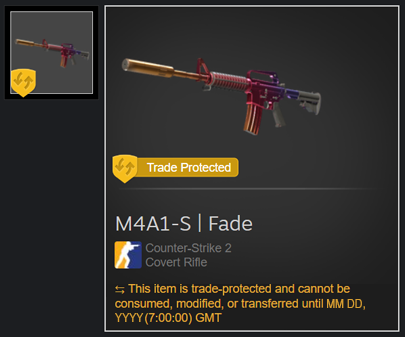
In mid‑July 2025, Valve introduced Trade Protection for Counter‑Strike 2 (CS2)—a security enhancement that allows either party to reverse a trade within a seven-day window. During this period:
- Traded items are flagged with a yellow shield icon, delivered to the recipient immediately, and remain usable in-game—but they cannot be sold, transferred, modified, or placed into storage.
- Reversals can be initiated directly from the Trade History page, without requiring Steam Support.
- Executing a reversal rolls back all eligible trades within that seven-day period and imposes a 30-day cooldown during which your account is blocked from trading or using the Steam Community Market.
Valve’s goal: empower users to reclaim stolen items after phishing or account hijacks, enhancing security in CS2’s high-value skin economy.
CS2 Skin Marketplaces: Adjusting to New Trade Realities
Skinport
- No longer allows listing or selling trade-locked items. They pause transactionability for items with a trade cooldown until the 7-day lock lifts.
Gamerpay
- Tightened security – permanent ban for anyone initiating a reversal. However, they still require users to go through support to retrieve funds, making their platform less user-friendly in practice.
Buff.163.com
- Their advanced automated systems detect trade reversals. Upon detection, money is instantly returned to the buyer – minimizing risk to purchasers.
Trading-Bot Marketplaces
- These platforms are least affected because they hold funds until the trade lock expires, so reversals can’t disrupt their model.
Instant Cashout Marketplaces
- Updated their “Instant Sell” system: payouts now can only be withdrawn once the trade lock expires – typically after eight days.
Broader Impacts of Trade Protection
- Slower trading pace: Instant cashouts are gone. Sellers must now wait at least 7 days before completing transactions.
- Liquidity constraints: Rapid arbitrage across marketplaces is hindered. Trade revocations complicate chain transactions, increasing escrow times and collateral needs.
- Trust rebalancing: The conditional nature of ownership (trade reversibility) introduces uncertainty -especially in peer‑to‑peer deals where one party could reverse out opportunistically.
- Market volatility fears: Some industry voices warn of potential price collapse due to reduced market fluidity and heightened uncertainty.
Trade Protection in a Nutshell: Quick Overview
| Feature | Details |
|---|---|
| Protection Period | 7-day lock; received CS2 items are usable but non-transferable/modifiable. |
| Reverse Feature | Trade History → one-click reversal of all eligible trades. |
| Cooldown | 30-day block on trading and Market post-reversal. |
| Cross-Game Limit | CS2 items can’t be traded with items from non-protected games. |
| Market Impact | Slower cashouts, platform adjustments, risk-limited liquidity. |
FAQ – Trade Protection in CS2
-
What exactly is Trade Protection?
-
How do I reverse a trade?
-
What happens after a reversal?
-
Can I still use or equip the item during the lock?
-
Can I trade CS2 items with other games?
-
Why did Valve implement this?
-
Is this feature coming to other games?
Conclusion
Valve’s Trade Protection is a clear win for user security—it empowers players to reverse fraudulent trades quickly. But it also upends how CS2’s skin economy functioned: trading is now slower, riskier, and requires new operational logic from marketplaces and traders alike.
If you’re navigating this new landscape—whether as a buyer, seller, or platform operator—adaptation is key. Transparency, trust mechanisms, and managing cash flow with extended holds are now the new normal.