
GamerPay was once one of the most interesting CS2 skin marketplaces in Europe. It had a strong concept, low fees, a clean design, and a peer-to-peer trading model that gave sellers a simple way to list skins while still keeping them in their Steam inventory until sale.
For a while, it worked. GamerPay built trust with a large part of the CS2 trading community and positioned itself as a safer alternative to informal cash trading. Social First later acquired GamerPay, presenting the deal as a step toward broader real-money trading infrastructure for in-game items. In its announcement, Social First described GamerPay as a trusted marketplace for CS2 skins and said the platform would keep operating with user accounts, balances, and listings intact.
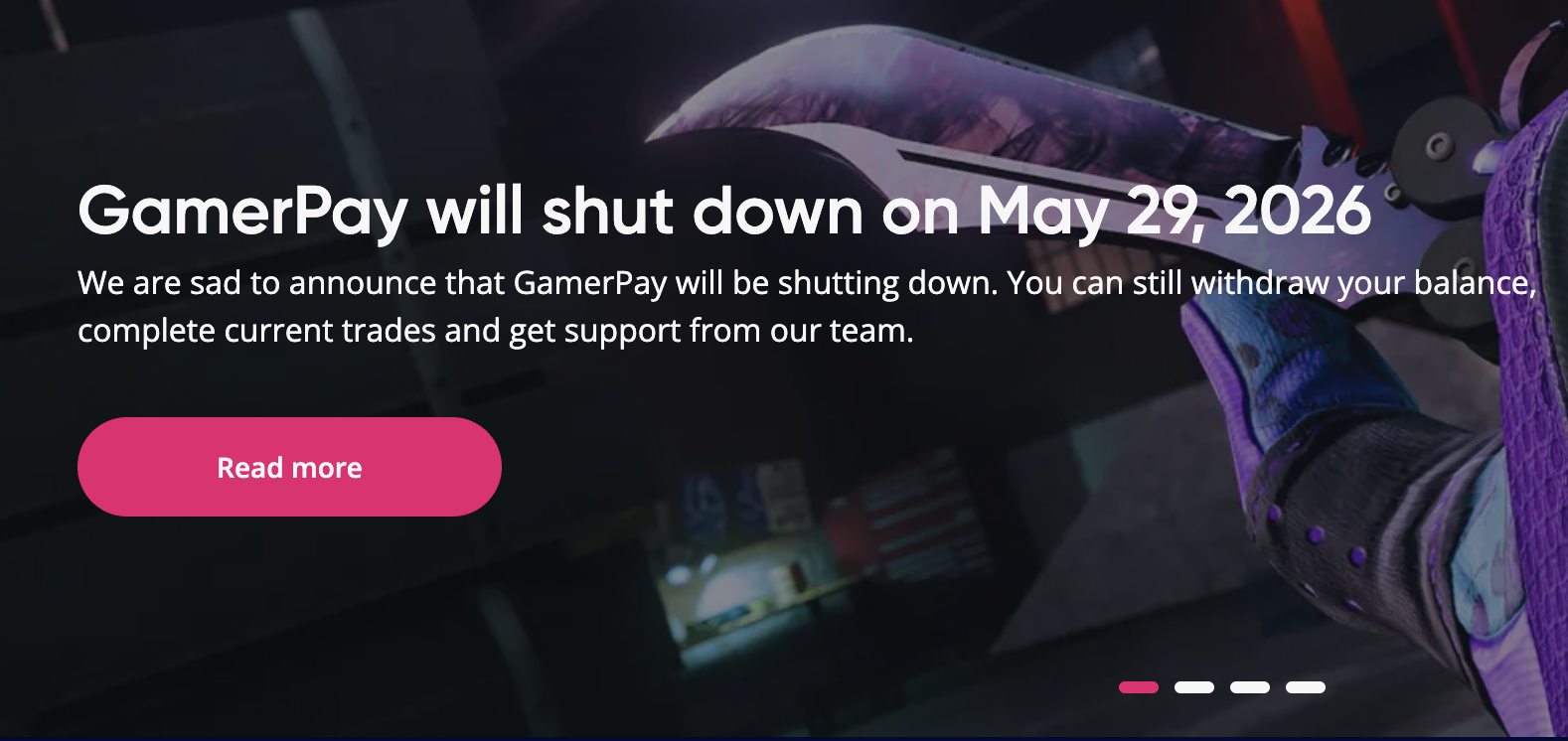
Only months later, the situation changed. GamerPay announced it would shut down on May 29, 2026. New deposits stopped, trading and new listings ended on May 8, and the remaining period focused on helping users withdraw their balances.
Now, after the collapse, the GamerPay domain and brand are being sold. For many traders, this marks a strange end to a platform that had the right idea, strong early community support, and better fees than much of the competition.
Where GamerPay Started Going Wrong
As someone who has worked with CS2 skin trading since 2019, I believe GamerPay’s decline started in August 2025.
That timing matters because the CS2 market had changed. Valve’s trade protection update created new risks for peer-to-peer marketplaces, especially platforms that relied on manual disputes and support tickets instead of stronger automated trade verification. I covered this shift in my article CS2’s New Trade Protection: What It Is and Why It Matters, published on August 14, 2025.
The problem was not only the update itself. The problem was how GamerPay handled the new trading reality.
GamerPay’s dispute process was mediocre, to say the least. As a buyer, you often had to stay online constantly so you would not miss a purchase delivery. If the seller marked the item as delivered, even when they had delivered nothing, you had a limited window to dispute it. In many cases, buyers had around 18 hours to provide proof that the seller had not delivered the item.
For casual buyers, this was annoying. For active traders buying tens of skins per day, it became a mess.
When you handle many transactions every day, you need a system that works without forcing you to manually watch every purchase. You need clear delivery tracking, automated checks, fast buyer protection, and dispute handling that does not punish the person bringing volume to the marketplace.
GamerPay did not offer that experience.
How the Dispute System Hurt Serious Traders
The core issue was simple: the platform placed too much responsibility on the buyer.
If you bought a skin and the seller falsely marked it as delivered, you had to notice it, gather proof, contact support, and dispute the trade within a short time window. When you buy one or two items, that is manageable. When you buy dozens of skins per day, it becomes easy to lose track.
Eventually, some trades would slip through. A sale would get confirmed as delivered, the seller would receive the money, and the buyer would not receive the skin.
That kind of experience kills confidence. Serious traders do not keep using a marketplace where missed support windows can turn into direct losses. They move their volume elsewhere. Personally I contacted support even after the 18h window was over with proof, and I was always awarded the money back by support, even after the 18h window, but it was a ridiculous process every time.
In my opinion, this is what started pushing major traders away from GamerPay. Once high-volume traders leave a peer-to-peer marketplace, liquidity starts to suffer. Fewer serious buyers means sellers get worse results. Worse seller results lead to fewer listings. Fewer listings lead to less buyer interest. The cycle feeds itself.
GamerPay Had Real Potential
The frustrating part is that GamerPay was not a bad idea.
It had a cool concept. The fees were great, far better than many competing platforms. The design felt original. The platform had personality, and at its best, it made CS2 trading feel easier and more modern.
That is why the downfall feels avoidable.
GamerPay did not fail because the idea was weak. It failed because the execution did not keep up with the market. After Valve introduced new trade protection mechanics, P2P marketplaces needed stronger infrastructure and faster protection systems. GamerPay needed to make disputes easier, not harder. It needed to listen to active traders, because those traders were the people stress-testing the platform every day.
I tried reaching out to the owner of the site countless times with suggestions for improvement. Once it became clear that I was bringing feedback rather than praise, I was ignored.
That attitude showed in the product. When a marketplace depends on trust, ignoring experienced users is expensive.
The Acquisition Did Not Save GamerPay
When Social First acquired GamerPay, it looked like the platform might get a second life. Social First described the acquisition as a chance to expand secure real-money trading and improve the platform with more resources and a longer-term vision.
That did not happen.
Instead, GamerPay announced its shutdown only months later. For users, the shutdown plan focused on withdrawals and closing trades rather than rebuilding the marketplace.
In a way, I pity the company that purchased GamerPay. Buying a once-promising marketplace and ending up with a bankrupt brand less than a year later is rough. Still, the warning signs were already there. The market had shifted. Active traders were frustrated. The platform had support and dispute problems that should have been fixed before they became existential.
What Happens to the GamerPay Brand Now?
The GamerPay domain and brand are now being sold after the bankruptcy. That leaves an interesting question: does the brand still have value?
I think it does, but only in the hands of someone who understands CS2 trading from the inside.
The name still means something to traders. The design was memorable. The platform processed serious volume during its best years. But any future version of GamerPay would need to start with trust, automation, and buyer protection.
A revived GamerPay would need:
- Clear proof of delivery
- Automated dispute triggers
- Longer and fairer buyer protection windows
- Better trade tracking for high-volume buyers
- Faster support escalation
- Transparent handling of failed or reversed trades
- Systems built for traders who buy and sell every day
Without those changes, the brand alone will not save it.
For traders who still need a reliable place to buy or sell CS2 skins, the lesson is simple: choose a marketplace with clear delivery tracking, fair buyer protection, and enough liquidity to support serious trading. You can compare current options and find safer CS2 skin trading platforms on the cs2skinsmarket.gg homepage.
I have personally reached out to Social First’s CEO with an offer of €1,000 for the gamerpay.gg domain XD. I do not expect a reply, but every shot you do not take is a shot missed.
Final Thoughts about GamerPay
GamerPay’s story is a lesson for every CS2 marketplace.
Low fees and good design are not enough. In skin trading, trust is the product. If buyers feel exposed, they leave. If high-volume traders lose confidence, liquidity leaves with them. If support becomes the main protection system, the platform has already fallen behind.
GamerPay had the foundation to become one of the strongest CS2 marketplaces in Europe. Instead, poor management, weak dispute handling, and a slow response to market changes pushed traders away.
The result is clear: a platform that once looked like one of the best ideas in CS2 trading is now shutting down, with its domain and brand looking for a buyer.